Mapping Hajj

What is Hajj?

Every year, millions come to Makkah and move together around the Kaaba in one of the most powerful displays of faith on Earth. This is a meeting point of belief, history, and modern engineering.

Hajj is the annual pilgrimage to Makkah: one of the five pillars of Islam and a duty for every Muslim who is physically and financially capable of making the journey. Over several days, pilgrims follow a sequence of sacred rituals that symbolize faith and unity. Beyond its spiritual meaning, Hajj is also a logistical marvel, mobilizing millions across deserts and vast temporary sites built to sustain them.

1,707,301

pilgrims performed Hajj in 2026

Before anyone reaches Makkah, the pilgrimage has already begun. Worshipers cross one of five fixed boundary points known as Miqat. At the Miqat, pilgrims enter a state of sacralization called Ihram. They put on simple clothing, make the intention for Hajj, and follow a set of restrictions that strip away status, routine, and distraction.

Five pillars of Islam

  • Shahada

    Testimony

    Affirming Allah's Oneness and Muhammad's Prophethood

    Testimony
  • Salah

    Prayer

    Praying five times daily

    Prayer
  • Zakat

    Charity

    Giving to those in need

    Charity
  • Sawm

    Fasting

    Fasting during Ramadan

    Fasting
  • Hajj

    Pilgrimage

    Performing Hajj in Makkah

    Pilgrimage

Explore Hajj

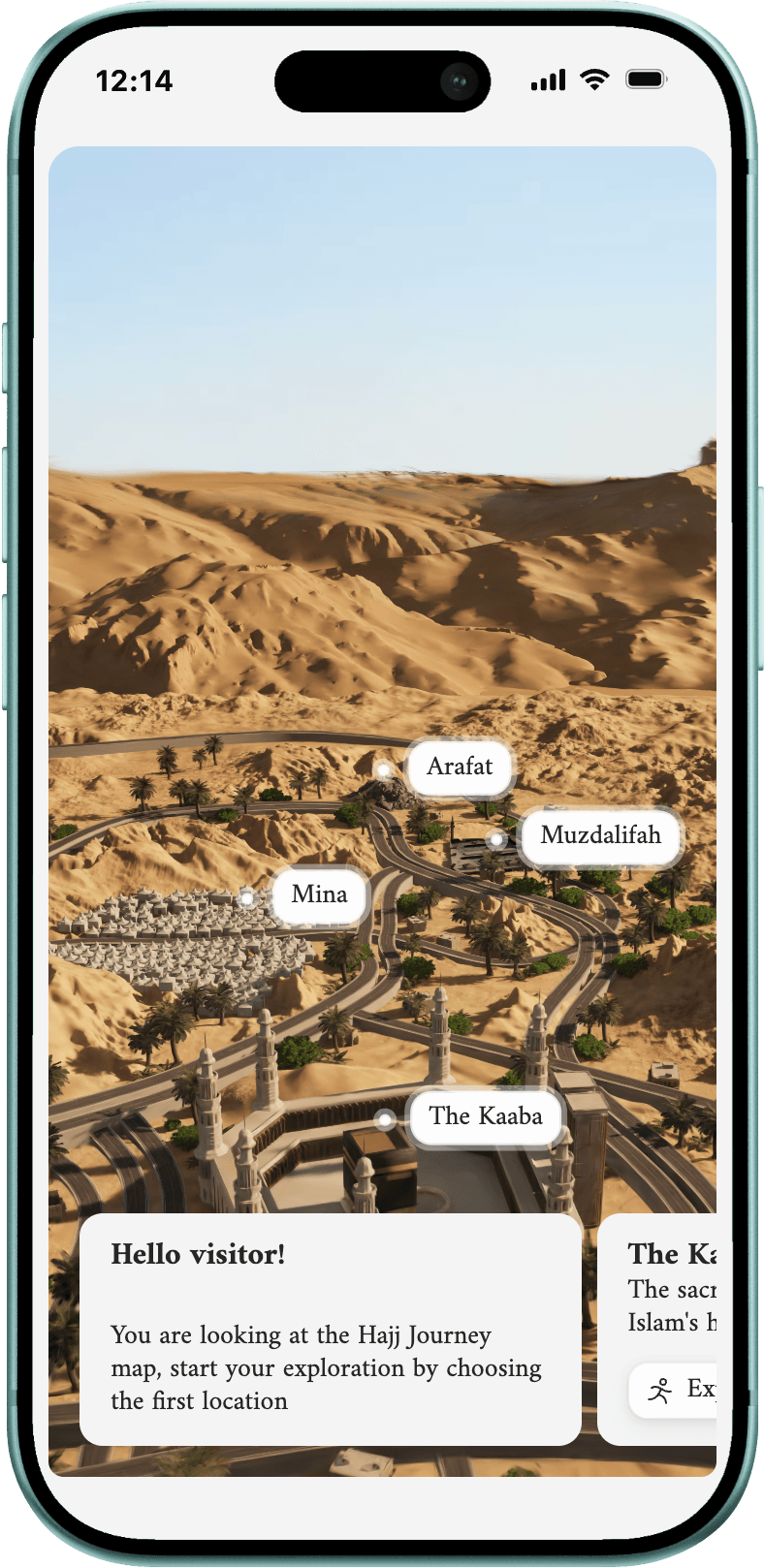
On this 3D map, we show the Hajj route through the Holy Sites, revealing their geography and scale.

The route begins

At the start of the route, many pilgrims circle the Kaaba seven times, then walk between Al-Safa and Al-Marwah inside Makkah’s Grand Mosque.

Circling the Kaaba

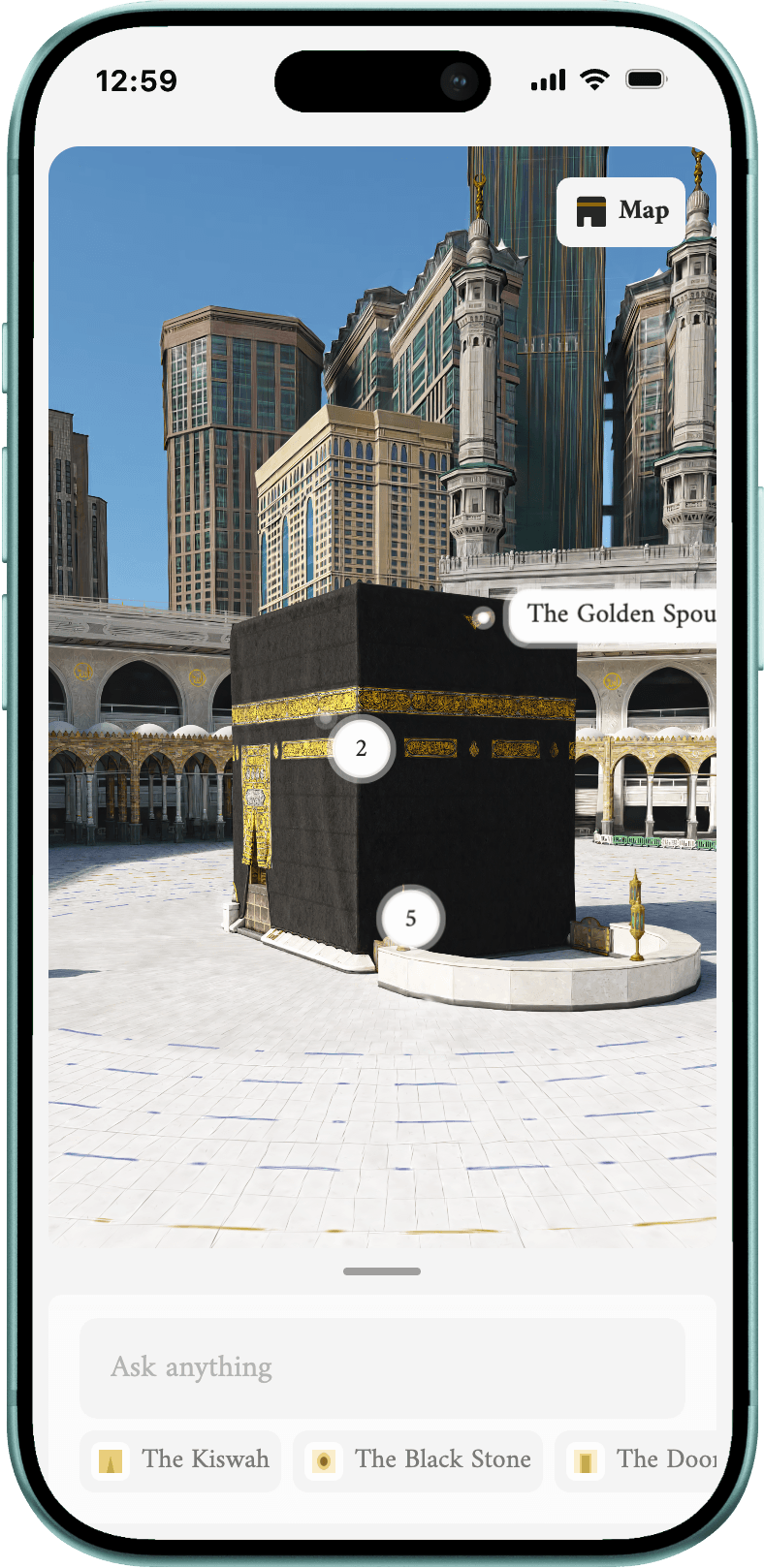
Our journey starts at the Kaaba, the cube-shaped "House of Allah" in the heart of Makkah’s Grand Mosque. Although the required rituals of Hajj begin in Mina, many pilgrims first head to the Kaaba to perform Tawaf upon their arrival in the Holy City. For this iconic ritual, they circle the Kaaba seven times in a counterclockwise direction. As a symbol of the sacralized state (Ihram), men wear simple white garments, while women dress modestly, covering their hair and body. Moving around the Kaaba, they embody humility and the equality of all before Allah.

Tawaf, the circling of the Kaaba, dates back to the time of the Prophet Ibrahim (Abraham) and symbolizes keeping Allah at the center of one’s life. The ritual begins and ends at the corner with the Black Stone, which pilgrims honor by kissing it, touching it, or raising a hand toward it in a gesture known as Istilam. Pilgrims perform the ritual of Tawaf several times during Hajj. They will return here after visiting Mina, Arafat, and Muzdalifah.

Photo: Nurlan Mammadzada/Alamy.com

Walking between two hills

After completing Tawaf, pilgrims perform Sa’i, walking seven times between the nearby hills of Al-Safa and Al-MarwahAl-Safa and Al-Marwah used to be on open ground at the edge of the Grand Mosque, with people walking between them through the city landscape. As the mosque expanded over the centuries, the builders enclosed the walking route and folded it into the mosque complex. Today, pilgrims perform Sa’i in a long, purpose-built passage rather than outdoors.

The ritual recalls Hagar’s search for water for her son Ismail (Ishmael) after her husband Ibrahim left them in the desert at Allah’s command. When she turned to heaven for help, Allah revealed the well of Zamzam, which still flows today. Sa’i embodies endurance, faith, and the belief that help arrives when hope seems lost.

Day 1

Pilgrims move to Mina, a temporary tent city east of Makkah. For a few days, the desert valley becomes one of the densest human settlements on Earth.

The city of tents

The next stop is Mina, a valley about five kilometers east of Makkah that turns into a vast camp during the pilgrimage. Known as the "City of Tents", it spans 2.5 million square meters and can house more than two million people.

Rows of identical white tents erase social divides: everyone eats, prays, and sleeps in similar simple conditions. Each unit connects to centralized cooling, essential in a valley where summer temperatures regularly rise above 40°C. Paved corridors run between camps. Lighting, signage, fire suppression systems, and utilities are built in. The layout operates with the logic of a planned city.

By nightfall, the valley hums with quiet recitation and rest, following the Prophet Muhammad’s example, who began his pilgrimage here on the eighth day of Dhu al-Hijjah. For the next 5 days, the valley will become the pilgrims' point of return, rest, and spiritual contemplation.

Photo: Hasan Hatrash/Shutterstock.com

Hajj takes place in the Islamic month of Dhu al-Hijjah, the twelfth and final month of the lunar calendar. For example, pilgrims arrive in Mina on the 8th of Dhu al-Hijjah.

Because the Islamic year is about 11 days shorter than the solar year, the dates of Hajj shift each year relative to the Western (Gregorian) calendar. Over time, the pilgrimage moves through every season. In 2026, Dhu al-Hijjah starts on May 18 and ends on June 15.

After a few days of Hajj, people will depart Mina. It will no longer be one of the most densely populated places on Earth. The structures will remain in place, fabric folded beneath the frames, waiting for the next pilgrimage.

Day 2

From Mina, pilgrims travel to Arafat for the central moment of Hajj. From noon to sunset, they gather on the open plain for prayer and repentance.

The spiritual heart of Hajj

Next comes Arafat, a wide plain about 15 kilometers east of Mina, the most important stage of the pilgrimage. Unlike Mina, the landscape here is mostly open ground with limited permanent structures.

From noon to sunset, millions of pilgrims stand or sit together in prayer, asking Allah for forgiveness. The stillness of the plain contrasts with the vastness of the crowd, creating a powerful sense of unity and humility. Arafat is the spiritual heart of Hajj. The Prophet Muhammad considered standing here crucial to pilgrims, as it could free them from the Hellfire. Muslims around the world mark the same day with fasting and prayer.

Photo: Hasan Hatrash/Alamy.com

At the center of the plain stands Jabal al-Rahmah, the Mountain of Mercy, a hill about seventy meters high. Small in scale, it has become the visual focal point of Arafat.

Islamic tradition holds that the Prophet Muhammad stood here during his final pilgrimage in 632 and delivered the Farewell Sermon to the crowds gathered across the plain.

The ritual performed at Arafat is called Wuquf, the standing at Arafat. From noon until sunset on the 9th day of Dhu al-Hijjah, pilgrims remain within the boundaries of the plain, praying, reflecting, and asking for forgiveness. In Islamic law, this is the essential moment of Hajj: without it, the pilgrimage is not valid.

This is the Day of Arafah, widely regarded as the emotional high point of the journey. Here, Hajj pauses. The focus shifts from movement to stillness, from procession to prayer.

Night 2

After sunset, pilgrims leave Arafat for Muzdalifah. They spend the night under the open sky, pray before dawn, and collect the pebbles they will carry back to Mina.

A night under the open sky

After sunset, pilgrims leave Arafat and travel to Muzdalifah, an open plain about halfway back to Mina. They spend the night under the stars, with no tents or shelters, resting briefly on mats or sheets laid on the ground. The evening is devoted to prayer and reflection. Here, pilgrims also gather small pebbles from the earth for the next rituals in Mina.

The stillness of Muzdalifah invites humility. Lying beneath the sky with only the ground for a bed reminds each pilgrim of life’s simplicity and its short span before resurrection. At dawn, the crowd rises together and sets out once more for Mina to complete the next stage of the rites.

Photo: Arisdp/Wikipedia.org

In Muzdalifah stands Masjid al-Mash'ar al-Haram, the Mosque of the Sacred Place, built on the site where the Prophet Muhammad is believed to have prayed during his Farewell Pilgrimage. He stopped here after leaving Arafat and before returning to Mina, making the site prominent in the Hajj sequence. Following Allah's command, the Prophet Muhammad dedicated the night here to remembering Allah Almighty.

Pilgrims pause in this area for prayer and reflection, emulating the Prophet's path. The mosque gives a fixed landmark to an otherwise open plain, linking this stage of the pilgrimage to a specific moment in Islamic tradition.

Days 3–5

Back in Mina, pilgrims cast pebbles at the Jamarat pillars over several days. They also offer the hady sacrifice and cut or shave their hair, marking Hajj’s final rites.

Stoning of the devil

Back in Mina, pilgrims perform Ramy al-Jamarat, the stoning of the devil, over three days known as the Days of Tashreeq. At this time, they cast no less than 49 pebbles, traditionally collected at Muzdalifah, at the stone walls known as Jamarat. On the first day, pilgrims throw seven stones at the largest of them, Jamrat al-Aqaba.

On the following days, they stone all three pillars—starting with the smallest, then the middle, and finally the largest—seven pebbles each. By performing this ritual, pilgrims commemorate the Prophet Ibrahim’s resistance to temptation when fulfilling Allah’s command to sacrifice his own son. According to the Islamic tradition, the devil challenged the Prophet not to follow Allah’s will. Ibrahim had to fight Iblis three times with stones to prove his commitment. Today, the three Jamarat mark the spots where this event happened.

First constructed in 1963 and expanded several times, the bridge now includes multiple tiers, ramps, and wide walkways connecting ground and elevated access points.
Photo: Hasan Hatrash/Shutterstock.com

The ritual marks the closing stages of Hajj, symbolizing the rejection of evil before pilgrims return to the Kaaba for the rituals of Tawaf and Sa'i. Modern redesigns of the Jamarat site, including a multi-level bridge and timed entry, have greatly improved safety for the millions of pilgrims.

The hady sacrifice

The first day of stoning at Mina coincides with Eid al-Adha, the Festival of Sacrifice. For pilgrims, Eid al-Adha is woven into the ritual of Hajj known as the hady sacrifice.

After the stoning, pilgrims offer an animal sacrifice in remembrance of Ibrahim’s test. According to the Islamic tradition, when the Prophet was about to sacrifice his son, Allah intervened and provided a ram instead.

Today, the sacrifice takes place in modern facilities near Mina, and most of the meat is distributed to those in need. It remains both an act of worship and an act of charity.

Next comes shaving the head for men, or trimming a small lock of hair for women, a gesture of spiritual renewal that marks leaving the state of Ihram.

The Farewell Tawaf

Finally, pilgrims return to the Kaaba. They circle it seven times once more, closing the route at the sacred Qibla.

Where the journey ends

Between the 10th and the 12th days of Dhu al-Hijjah, pilgrims move between Makkah and Mina to perform the already familiar rites: stoning of the devil (Ramy al-Jamarat), circling the Kaaba (Tawaf al-Ifadah), and walking between the Al-Safa and Al-Marwah Hills (Sa'i). The last seven circles around the House of Allah, performed on the 12th day of the month, are known as the Farewell Tawaf. This final ritual closes the Hajj sequence. After days of movement between distant sites, the journey resolves at the place to which Muslims turn five times a day in prayer. The act is both completion and return: a last passage through the shared rhythm that has defined the pilgrimage.

In practical terms, this moment gathers one of the largest coordinated flows of people back into a single space. Pilgrims re-enter the Grand Mosque, merge into the circulating crowd, and perform the ritual within a system designed to handle continuous high-density movement. The pattern is familiar by now, but its scale remains striking: thousands moving in synchronised paths around a structure that has anchored the pilgrimage for centuries.

A virtual guide to Hajj

The Balady+ app turns Saudi Arabia’s urban and municipal services into a live digital experience. Its 3D maps, local navigation, real-time updates and service layers make cities easier to move through, read and understand. For Hajj, this becomes especially powerful. Balady+ has been used to map the Holy Sites with detailed landmarks, transport stations, hotels, camps, routes and real-time closures, giving pilgrims a clearer, safer way to navigate one of the world’s most complex journeys.

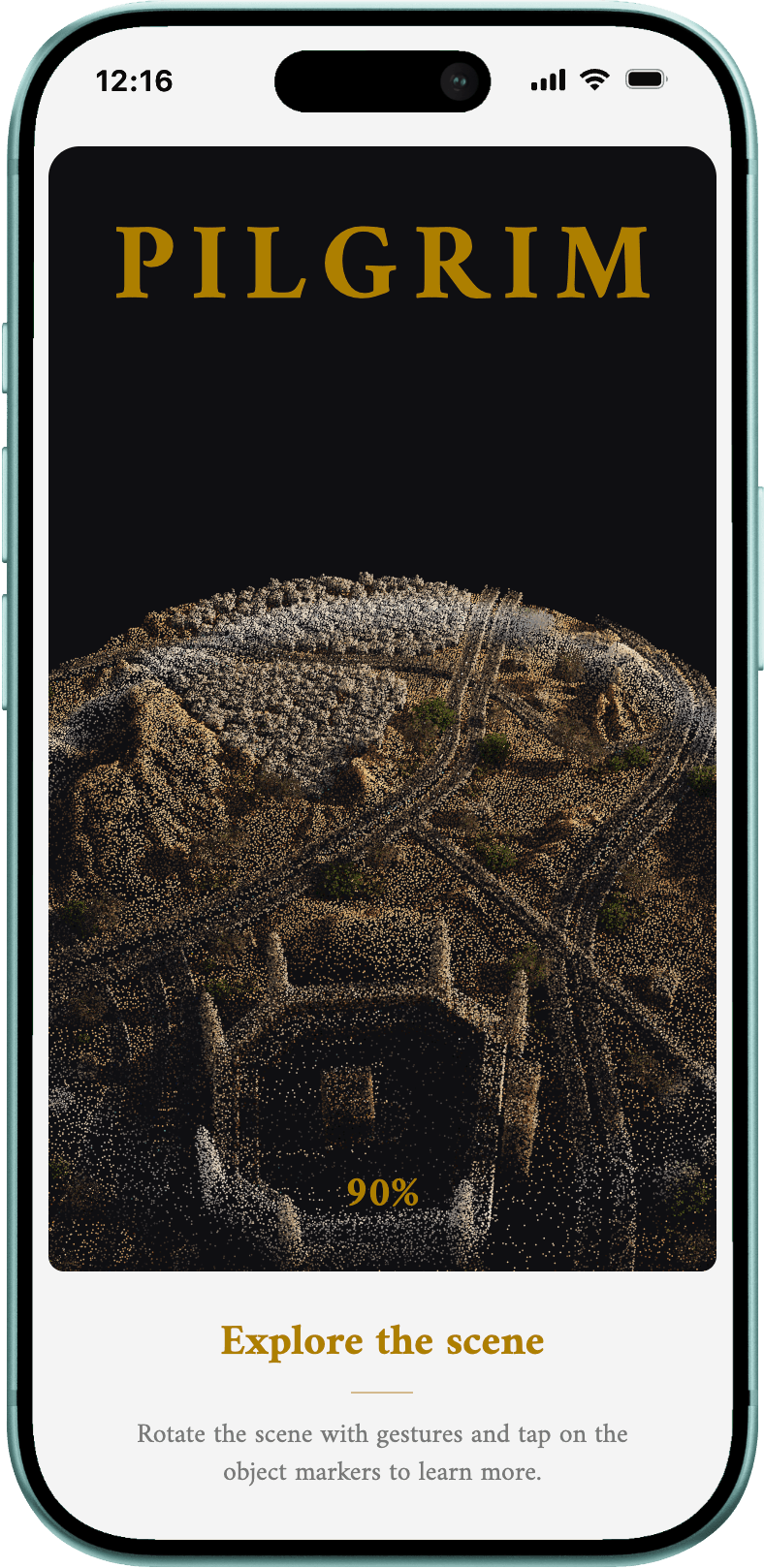
Now, you can also explore Hajj sites in immersive 3D with the Maqam Project, part of the Balady+ app. It’s a guided, spatial way to explore sacred places, rituals and movement through realistic 3D environments. You can interact with the scene directly in this feature, or scan the QR code to download Balady+ app and experience the full version.

  • Interactive journey mapNavigate the key locations of Hajj
  • Immersive 3D scenesExplore sacred sites in stunning detail
  • Learn as you exploreDiscover the history and significance of each place
Start your journey